Racha Noi: Into the Blue
· 9 min read · Destination Guide
There is a point south of Phuket where the familiar geography begins to loosen its hold. Mobile signal weakens. The sea loses its pale coastal tint. Racha Yai passes behind, and ahead there is only open Andaman water, darkening towards a blue so saturated it appears almost mineral.
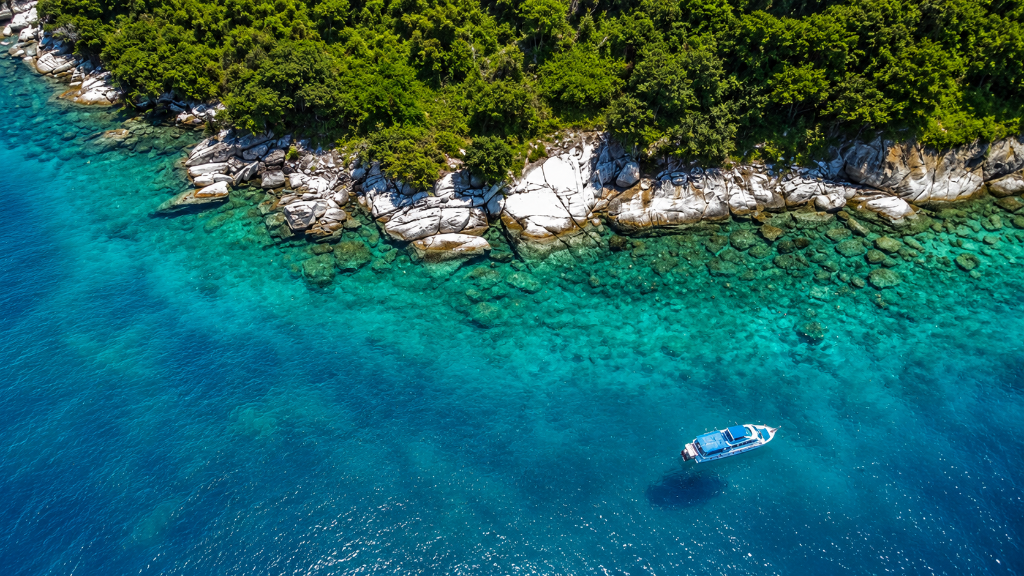
Racha Noi emerges gradually, not as a tropical idyll but as a long granite spine, its hills folded beneath scrub and forest, its edges broken by immense stone. There are no beachfront hotels arranged to greet the boat, no village gathering around a pier, no row of umbrellas waiting on the sand. The island offers almost nothing by way of introduction.
That austerity is precisely its allure.
Racha Noi belongs to the deeper sea. It is an island for divers, strong swimmers, seasoned boat crews and travellers who find luxury not in elaborate service, but in reaching water that still feels consequential.
Beyond Racha Yai
The distinction between the two Racha islands is apparent before arrival.
Racha Yai has sheltered bays, white beaches and the polished ease of a resort island. Racha Noi lies farther south, where the crossing is longer and the conditions less forgiving. Its coves are narrower, its slopes more severe and its underwater terrain far more dramatic.
Approaching from the north, the island seems assembled from granite on a monumental scale. Rounded boulders crowd the shoreline in improbable arrangements, as though a landslide had been arrested just before entering the sea. Some are sun-bleached and smooth; others wear dark tidal marks and skirts of barnacles. Beneath the surface, the same formations continue downward, creating channels, pinnacles and walls around which the water accelerates.
Nothing about Racha Noi feels decorative. Its beauty has weight.
An Island Best Understood Underwater
Above the waterline, Racha Noi can appear almost reticent. Below it, the island becomes elaborate.
Granite ridges descend through blue water in terraces. Pale sand collects in the spaces between boulders. Coral grows over the stone in irregular gardens, softening its mass with fans, sponges and anemones. Clouds of fusiliers move across the reef with the precision of thrown silk, turning all at once when a larger shadow passes beneath them.
The sea here is rarely static. Currents divide around submerged rock and gather again on the other side. Cooler water may rise from the depths without warning, changing the temperature in a few fin strokes. Visibility can open astonishingly far, allowing divers to see the architecture of the reef descending beyond them, then close again as plankton moves through.
It is this plankton-rich water that helps draw larger marine life. Manta rays are the great hope of Racha Noi, particularly around the island's more exposed southern sites. They arrive without ceremony, appearing first as distant shapes before their wings resolve against the blue. A manta does not seem to swim so much as alter the water around itself, turning with immense composure while smaller fish scatter beneath it.
There are no guarantees. Racha Noi is not an aquarium, and its finest encounters cannot be scheduled. The possibility is part of the seduction.
The South Tip
At the island's southern extremity, the seabed falls into the open Andaman and the current can move with formidable purpose. The South Tip is among Racha Noi's most celebrated dive sites, and one of its least casual.
Beneath the surface, boulders form a submerged landscape of ridges and passages. Soft corals take hold where the water brings nutrients, and schools of barracuda may gather beyond the reef in silver formations. Eagle rays, tuna and manta rays are occasional visitors, moving through the blue beyond the granite.
The site demands experience. Current can change rapidly, and the island's remoteness leaves little room for careless judgement. For capable divers, however, this exposure is precisely what gives the place its intensity. There is the reef beneath, the open ocean beside it and the constant awareness that something larger may materialise at the edge of vision.
Racha Noi is at its most compelling when it refuses to behave like a conventional island destination.
The Otherworldly Colour of Banana Bay
On the eastern side of the island, Banana Bay offers a gentler counterpoint to the deeper southern sites. The bay takes its name from the curve of its shoreline, though from the boat it is the colour that registers first.
The water passes through several blues within a few metres. Over sand, it is almost translucent, faintly green where sunlight reaches the bottom. Beyond the shallows, it deepens suddenly into a brilliant, lucid cobalt. Dark granite and submerged reef appear beneath the surface like ink dropped into glass.
When conditions are calm, the bay is one of the better places for snorkelling. Coral heads rise from the sand, and small reef fish move between them in flashes of yellow, white and electric blue. The beach itself is modest, framed by rock and vegetation rather than the broad sweep found on Racha Yai. Its appeal is not social. There is nowhere to promenade, nowhere to order a cocktail, nowhere to be seen.
The boat becomes the day's salon, dining room and private terrace. Lunch is eaten beneath the canopy with wet hair, bare feet and the island held at a discreet distance. The sea performs all the decoration required.
Granite Bay and the Western Shore
Racha Noi's western side feels more exposed, shaped by the full reach of the Andaman. Here, the granite appears darker and the water often carries more movement. Waves strike the rocks with a low concussion, leaving white water suspended briefly in the fissures before it drains away.
Underwater, the formations become a sequence of massive blocks, some balanced upon one another, others separated by sandy corridors. Divers pass between them as though moving through the ruins of an impossible city. Light falls differently here, entering in broken columns and leaving the lower sections in blue shadow.
The western sites are especially sensitive to weather and season. A calm morning may offer beautiful visibility and compelling dives; an exposed afternoon may render the same coast unsuitable. Racha Noi does not reward stubborn itineraries. It requires responsiveness, restraint and a crew willing to turn away.
That capacity to abandon a plan is not failure. At sea, it is expertise.
A Rare Kind of Day
A day at Racha Noi is built around immersion rather than sightseeing.
The crossing begins early, with Phuket disappearing behind the boat and breakfast served as the sea becomes steadily deeper in colour. Conversation quiets naturally during the final approach. There is less to look at in the conventional sense, yet the horizon becomes more absorbing precisely because it is so spare.
At the first anchorage, divers prepare their equipment while snorkellers study the water from the platform. The entry is immediate and clean. One moment there is heat, engine noise and the gleam of the deck; the next, cool blue closes overhead and the island reveals the part of itself that cannot be seen from land.
Between swims or dives, the boat shifts position along the coast. Towels dry in the sun. Salt gathers on shoulders and railings. Lunch arrives without interrupting the mood, perhaps grilled fish, rice, fruit and something sharp with lime and chilli. There is no need to dress for it or go ashore.
The afternoon is decided by the sea. If visibility is strongest in a northern bay, the boat returns there. If the current has softened around a reef, there may be one final descent. If conditions deteriorate, the captain turns home early and without apology.
The true indulgence is not forcing the island to provide a predetermined experience.
For the Traveller Who Has Seen Phuket Before
Racha Noi is not the place to choose for a first, easy introduction to island life. It is too distant for casual curiosity and too dependent upon conditions to promise a polished sequence of beach, lunch and photograph.
It suits travellers who already understand that the Andaman is more than its beaches. Divers come for the possibility of manta rays and the challenge of current. Snorkellers come for clarity and reefs removed from the most heavily travelled circuits. Yacht guests come for the pleasure of spending a day beyond the visible edge of Phuket's tourism.
There is status in reaching Racha Noi, but not the conspicuous kind. It is the quiet distinction of having selected the more difficult place because the difficulty preserves something.
Returning North
On the journey back, Racha Noi diminishes quickly. Its separate coves and granite shelves merge into one dark shape, then into a low mark on the horizon. Racha Yai appears first, followed eventually by the softened outline of Phuket.
After a day in deep water, the coast can seem unusually crowded with detail. Buildings, marinas and green hills assemble themselves again. Phones recover their signal. Messages arrive. The ordinary world resumes with indecent speed.
What remains is not the memory of a particular beach or a carefully staged lunch. It is the colour beneath the boat, the sudden cold of an upwelling current, the scale of granite disappearing into depth and, perhaps, the shadow of a manta moving through open water with nothing above it but sun.
Charter a Private Boat to Racha Noi
Reach Racha Noi's granite reefs, deep-blue dive sites and Banana Bay by private twin-engine speedboat or larger vessel from Chalong.
View Racha Noi