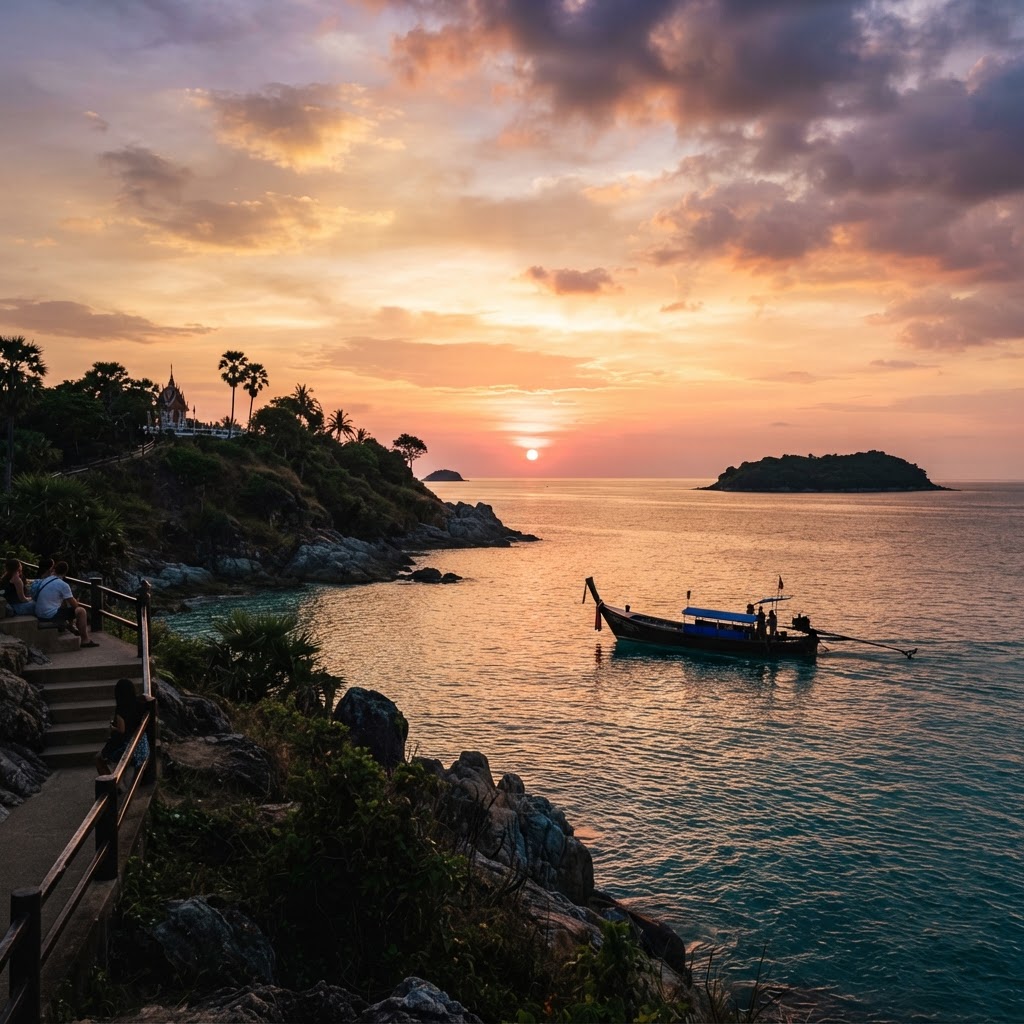
Promthep at Sunset: The Evening Phuket Slips into the Sea
· 12 min read · Coastal Journal
By five o'clock, the heat has begun to loosen its grip on southern Phuket. The glare on Rawai Bay softens. Longtail boats return in uneven lines, their narrow bows cutting through water the colour of smoked glass. Along the shore, engines cough into silence, ropes are looped around wooden posts, and the day's final passengers step onto the sand carrying wet towels and plastic bags of fruit.
Your boat turns away from the beach.
Rawai recedes behind a scatter of hulls, restaurant roofs and casuarina trees. Ahead, Ko Man sits low beyond Ya Nui, while Promthep Cape extends into the Andaman like the prow of some immense, weathered vessel. From this angle, the famous viewpoint is almost irrelevant. What commands attention is the land beneath it: a long rib of scorched grass, wind-bent palms and black granite falling steeply into moving water.
The sun is still high enough to warm your face. There is time before sunset, though nothing about the next two hours should be hurried.
Leaving Rawai
The boat travels west along Phuket's southern edge, where the coast is compressed into steep headlands and pocket-sized beaches. Houses appear briefly between trees, then disappear behind stone. Laundry hangs on one hillside. A shrine flashes gold through the foliage. The smell of charcoal from the seafood restaurants survives for a few minutes before salt and warm diesel take over.
At the bow, the air is cooler. Ribbons tied above the longtail's prow stream backwards, red, yellow and blue against the dark wood. Each time the hull meets the shallow chop, fine spray rises and settles over bare arms.
Ya Nui comes into view as a small curve of sand divided by rock. Kayaks cross the channel towards Ko Man, their paddles dipping in unhurried rhythm. The beach is close enough to distinguish individual umbrellas, but the boat continues beyond it, entering the deeper water where the cape begins.
Promthep does not resemble the polished silhouette seen in travel brochures. Its lower slopes are rough and fractured. Granite ledges protrude beneath the vegetation. Sea foam gathers in crevices and vanishes. The palms along the ridge are sparse, their trunks bent inland by years of wind.
High above, people have already begun taking their places for sunset.
From the boat, they are no more than pale dots along the railing.
The Swim Before Dusk
The captain chooses a pocket of calmer water behind Ko Man, where the late sun reaches the seabed in wavering columns. The anchor drops with a rush of chain, and the boat turns until its bow faces the swell.
The water is warm at the surface, then suddenly cooler around the legs. Below, pale sand is broken by rounded stone and darker fans of sea grass. Small striped fish hold themselves close to the rocks, retreating whenever a swimmer approaches and returning as soon as the water settles.
Looking towards Phuket, Promthep fills the horizon. The cape appears much taller from sea level. Its ridge rises in a single darkening slope, grass burnished yellow above the granite and palms standing apart against the sky.
There is no need to swim far. The pleasure is in floating, ears beneath the water, while the noises of the boat become muffled knocks and distant vibrations. When you lift your head, the landscape has changed almost imperceptibly. The sun is lower. The stone has begun to take on colour.
Back on board, cold water is poured into glasses beaded with condensation. Slices of pineapple and watermelon arrive on a wooden tray, their colours unnaturally bright in the declining light. Salt dries across shoulders. Hair is combed back with fingers. Someone unfolds a linen shirt and puts it on without fastening the buttons.
The boat begins moving again.
Rounding the Cape
As the vessel passes the southern point, the water grows more restless. Swell folds around the cape from the west, lifting the hull beneath you in slow, muscular movements. The captain adjusts the engine and keeps a deliberate distance from the rock.
Here, Promthep shows its most severe face.
The cliff is neither uniformly grey nor black. It is veined with rust, ash and the muted green of algae near the tide line. Narrow shelves project from the rock, polished by spray. In one recess, the sea gathers into a dense bottle-green before breaking white against the wall. Above it, dry grasses lie flat in the wind.
The western light reaches directly into every fissure. Surfaces that looked flat an hour earlier acquire depth. One boulder glows the colour of old copper; another remains blue-grey in shadow. The cape seems to change material as the boat moves, from stone to bronze to something almost violet.
A Brahminy kite circles above the ridge, its pale head catching the sun before it turns and becomes a dark shape again.
The boat's engine is lowered.
Without its steady mechanical note, the cape sounds larger. Water draws back over rock with a low, granular sigh. Waves strike the base of the cliff and reverberate through hollows that cannot be seen. Wind combs through the palms above.
The people at the viewpoint remain visible, but the distance erases their voices.
The Hour Before Sunset
The final hour is more beautiful than the sunset itself.
Light gathers along the western face of Phuket, touching every raised surface while leaving the hollows cool and dark. A fishing boat crosses beneath the cape, blue hull faded to chalk, its canopy patched with green tarpaulin. A man stands at the stern with one hand on the tiller, apparently indifferent to the spectacle surrounding him.
Farther out, the horizon is not a clean line. It is layered with heat, thin cloud and the faintest residue of island silhouettes. The sun, still bright, hangs above this haze in a sky washed from blue to pale gold.
The boat drifts rather than anchors. Its position changes constantly by a few metres, so the cape appears first beside the sun, then beneath it, then farther to the east. Glasses slide gently on the table and are steadied by hand. Ice shifts in the cooler.
No one needs to be told to look.
The grass at the top of Promthep turns luminous. Individual palms sharpen into black calligraphy against the sky. The granite below grows darker, yet retains a narrow amber edge wherever the sun still reaches it.
Behind the cape, Phuket's green hills begin stacking themselves in softer shades. Nai Harn is concealed beyond the ridge, but a few white buildings catch the light in the distance. Out towards the sea, yachts have positioned themselves for the same hour, their sails lowered, hulls facing west.
There are other boats, certainly. This is not solitude manufactured for a photograph. Yet the water disperses them. Each vessel occupies its own moving circle of sea, near enough to be visible and far enough that conversation remains private.
When the Sun Descends
The sun changes character as it approaches the horizon. It loses its fierce white centre and becomes a distinct sphere, orange at first, then deepening towards vermilion.
A strip of cloud crosses its lower half.
For a moment, the sun seems cut in two, the upper portion clear and the lower blurred into bands of rose, apricot and smoke. The water beneath it begins to shine, not as one smooth reflection but as thousands of bright fragments assembled and broken by the swell.
The path of light reaches almost to the boat.
Every polished edge catches it: the rim of a glass, a metal clasp, wet skin, the lacquered curve of the bow. The sea around the hull turns black by comparison.
A longtail passes through the reflection. Its canopy, passengers and raised prow become a single dark silhouette, followed by a wake that breaks the gold into moving shards. For several seconds, the boat appears to be travelling across molten metal.
Then the sun reaches the haze.
Its lower edge softens first. The circle flattens slightly where sky meets sea, as though pressed against the horizon. Colour intensifies around it, while the rest of the sky becomes unexpectedly delicate: shell pink above, pale lemon near the water, a faint wash of lavender over the cape.
The final arc disappears quickly.
There is no applause on the boat. Only the click of ice against glass, the small slap of water against the hull and the captain restarting the engine before the current carries you farther west.
The Colour Afterward
The sunset is gone, but the evening has not reached its most beautiful point.
Promthep now stands in full silhouette, its ridge unmistakable, the palms reduced to thin black strokes. Behind it, the sky deepens from rose to mauve. The highest clouds retain a cool pink underside, while those nearer the horizon burn briefly in shades of persimmon and copper.
The sea reflects these colours without copying them. Close to the boat, it is dark blue with violet flashes. Farther out, broad passages of pink travel across the surface and break apart. The wake opens behind the stern in pale, luminous folds.
One by one, lights appear along Phuket's southern coast.
A green navigation light glows on a passing boat. Red follows on the other side. Rawai begins as a faint amber cluster beyond the cape, then resolves into individual lamps, restaurant signs and porch lights strung close to the shoreline.
The air changes temperature. After the day's humidity, the breeze against damp skin feels almost cool. Someone reaches for a shawl. The scent of fruit and sunscreen gives way again to salt, wood and engine smoke.
Above, the first star appears so faintly that it may at first be mistaken for an aircraft.
Returning Through Blue Hour
The journey back is not an afterthought. It is the part of the evening most people standing at the viewpoint never experience.
The boat follows the coast in near darkness. Granite outcrops become black masses beside the water. Ya Nui is marked by a few lights beneath the hill, while Ko Man disappears almost entirely except where its outline interrupts the glow from the sky.
The sea is still visible, though colour has drained from it. Each rise of the hull catches a narrow seam of silver. Near the stern, the propeller disturbs points of phosphorescence, tiny green-white sparks appearing and vanishing in the wake.
Rawai announces itself by sound before arrival. Engines. Music from a restaurant. Cutlery against plates. Voices carrying across the water. The shore that seemed distant and insignificant an hour ago grows steadily brighter.
Longtails are moored in rows again, now without colour, their bows etched against the lights behind them. The captain threads between them and slows. A crewman reaches for the mooring rope.
When your feet touch the sand, the island feels warmer than the water.
Behind you, Promthep is no longer visible.
The Promthep Evening Worth Having
The crowds above the cape come for a moment: the sun touching the horizon, the proof captured on a phone, the descent back to the car park.
A Promthep evening by boat is something else. It begins with Rawai still warm from the afternoon. It contains a swim under the cape, pineapple eaten with salt drying on your wrists, granite turning copper, fishing boats crossing through light, and the first stars appearing during the passage home.
Sunset is only one event within it.
What remains afterward is more physical than photographic: the change in temperature when the sun disappears, the lift of the hull around the headland, the smell of wet timber, the colour caught inside the boat's wake, and Promthep rising above the water until darkness removes it piece by piece.
Charter a Promthep Sunset Voyage
A golden-hour longtail, speedboat, catamaran or yacht from Rawai — swimming, rounding the cape and returning through blue hour.
View Promthep Sunset