Phi Phi Islands: Limestone, Light and the Andaman Sea
· 13 min read · Destination Guide
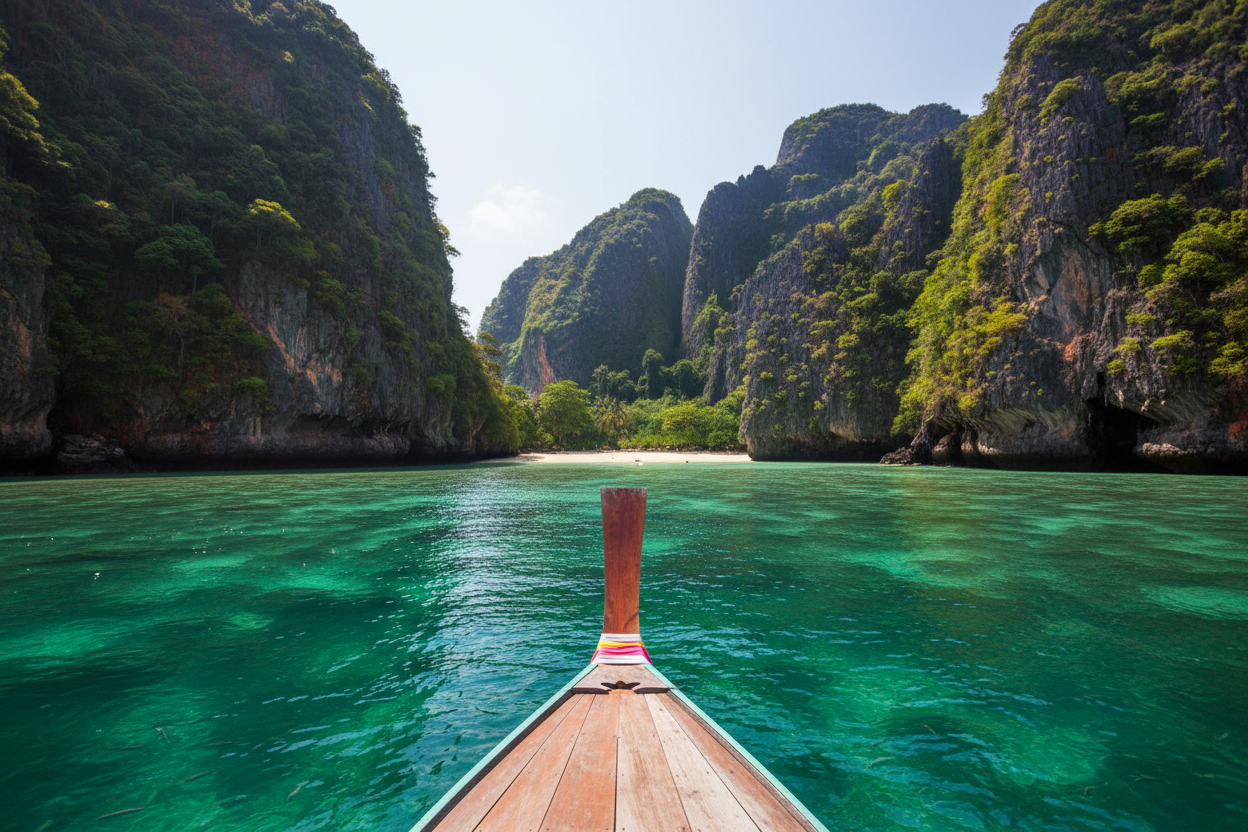
The first sight of Phi Phi is not a beach but a wall of stone. Limestone rises almost vertically from the Andaman Sea, dark at the waterline and thick with green above, its surface scored by rain, salt and centuries of weather. Longtail boats pass beneath it with painted bows and bright ribbons lifting in the wind, briefly reduced to flecks of colour against the cliffs.
The archipelago has been reproduced so often that it is easy to mistake familiarity for understanding. Yet the Phi Phi Islands are more intricate than their most famous photographs suggest. Phi Phi Leh is a citadel of rock, enclosing lagoons and concealed bays. Phi Phi Don narrows into a ribbon of sand between two seas before climbing into forested hills. Bamboo Island lies low and pale to the north, encircled by clear shallows. Beneath the surface are coral shelves, submerged rock and shoals of fish flashing silver whenever the light turns.
Phi Phi is undeniably popular. Its beauty has never belonged to one traveller alone. The art lies in experiencing it with intelligence: at the right hour, in the right sequence and with enough time to notice what remains after the postcard image has been taken.
Maya Bay
Maya Bay lies inside a vast limestone amphitheatre, its cliffs drawing around a crescent of pale sand and shallow, luminous water. From the beach, the entrance to the open sea appears almost narrow, framed by walls of rock tufted with palms and trailing vegetation.
The bay is now carefully managed following years of ecological pressure. Boats no longer land directly on the beach, swimming is restricted, and visitors enter through a designated route from the opposite side of Phi Phi Leh. These controls have allowed blacktip reef sharks and other marine life to return to the shallows, although access arrangements can change under national-park management.
The beauty is in the details that photographs tend to flatten: the faint blue shadow cast by the cliffs, young sharks drawing dark commas through the water, the powdery sand cooling beneath bare feet and the dense green crown of the island rising above the bay. Early light lends the limestone a silver cast. Later, the water brightens until it seems illuminated from below.
Maya Bay should be seen, but it should not be allowed to consume the entire journey. Phi Phi Leh has other landscapes of equal force.
Pileh Lagoon
Pileh Lagoon is entered through a break in the cliffs. The passage is modest at first, a corridor of green water between high rock, before the interior opens and the colour intensifies.
Here, limestone falls directly into the sea. There is no broad beach to soften the meeting of stone and water, only sheer mineral walls, overhanging foliage and depths that shift from jade at the edges to an extraordinary blue in the centre. Sunlight moves across the lagoon slowly, illuminating one face of rock while another remains cool and shadowed.
The atmosphere changes according to the hour. In the morning, the water has a dark, polished stillness. When the sun rises above the rim of the cliffs, turquoise begins to travel across the lagoon in broad shafts. Longtail boats anchor close to the rock, their wooden hulls reflected beneath them, while swimmers drift through water so clear that every movement seems suspended.
Pileh is busiest around the middle of the day. A private captain cannot make the lagoon empty, but careful timing can change its entire complexion. The finest moments often occur at the edges of the excursion timetable, when the sunlight is lower, the engine noise recedes and the water regains its glassy surface.
Around Phi Phi Leh
Away from the celebrated bays, Phi Phi Leh becomes stranger and more severe. The coastline is carved into overhangs, fissures and sea caves. Jungle clings to ledges that appear incapable of supporting soil. Rock faces descend into deep water stained emerald by shadow.
At Viking Cave, the limestone opens into darkness beneath a high, weathered ceiling. The cave is associated with the harvesting of edible swiftlet nests and is not ordinarily entered by visitors. From the water, its black mouth, bamboo structures and circling birds provide a glimpse of a livelihood that predates the island's modern fame.
Elsewhere, the geography continually rearranges itself. A headland that appears impenetrable reveals a channel as the boat changes angle. Small coves disappear behind folds of stone. Vertical surfaces carry streaks of rust, charcoal and chalk, like unfinished canvases washed repeatedly by monsoon rain.
The circumnavigation of Phi Phi Leh is not merely transport between named attractions. It is one of the most beautiful passages in the archipelago.
Phi Phi Don
Phi Phi Don possesses one of Thailand's most distinctive natural forms. Tonsai Bay and Loh Dalum Bay lie on opposite sides of a slender isthmus, their waters separated by a sweep of palms, hotels, paths and pale sand. Behind them, the island rises sharply into jungle-covered hills.
Tonsai is the arrival point and working harbour. Ferries nose towards the pier, longtails jostle at the margins and porters guide luggage through lanes lined with cafés, dive shops and small hotels. It is busy, animated and unapologetically social.
Cross the narrow centre of the island and Loh Dalum feels softer. The bay is broad and shallow, retreating dramatically at low tide to reveal wet sand rippled like silk. At higher water, longtails float close to shore and the surrounding hills appear doubled in the surface.
Above both bays, paths climb through tropical vegetation to the Phi Phi viewpoints. The ascent is steep enough to feel purposeful, particularly in the heat, but the reward is a complete understanding of the island's geography. From the summit, Tonsai deepens towards indigo while Loh Dalum remains pale and translucent over its shallow floor. The curve of the isthmus glows between them, framed by green hills and the distant shapes of Phi Phi Leh.
Arrive in the final hour before sunset and the familiar view becomes far richer. Roofs and palms lose their midday sharpness. The bays turn metallic, then rose-grey. Boats leave fine white lines across the water, and the limestone islands beyond recede into successive veils of blue.
Along the Coast of Phi Phi Don
Beyond the central village, Phi Phi Don fragments into coves, forested slopes and beaches reached by footpath or longtail boat.
Long Beach looks south towards the towering outline of Phi Phi Leh. Its sand falls into clear water, and the view across the channel gives the beach a grandeur that is difficult to convey in photographs. Nearby Shark Point is known for blacktip reef sharks, which may be seen gliding above the reef when visibility and sea conditions are favourable.
Further around the island, Loh Moo Dee, Loh Ba Kao and Laem Tong offer different expressions of Phi Phi Don. One is framed by jungle and coconut palms, another by a long sweep of sand and tidal flats, another by polished resorts set well apart from the movement of Tonsai.
Laem Tong, at the island's northern end, is particularly suited to travellers who prefer Phi Phi's scenery without living at the centre of its commotion. Here, sophisticated resorts occupy a long beachfront facing Bamboo Island and the open sea. Properties such as SAii Phi Phi Island Village and OUTRIGGER Phi Phi Island Resort offer private dining, spa experiences and more secluded accommodation, allowing the islands to be experienced with considerably greater privacy and comfort than the backpacker mythology implies.
Bamboo Island
Bamboo Island dispenses with Phi Phi's vertical drama. It lies low against the horizon, circled by pale sand and water that changes in visible bands from transparent shallows to turquoise and deep marine blue.
Casuarina trees occupy the centre, their fine needles moving softly above the beach. The open horizon gives the island an entirely different atmosphere from Phi Phi Leh, where cliffs dominate every view. Here, there is sky, glare and the long curve of the shoreline.
The surrounding reefs can offer good snorkelling when visibility allows. Small fish gather over coral patches, while the sandy floor reflects sunlight back through the water. Yet Bamboo Island's greatest luxury is elemental: stepping from a boat into warm shallows, finding shade beneath the trees and looking back across a sea crowded only by distant islands.
Timing matters. Around midday, excursion boats can gather quickly. Earlier or later, the scale of the beach has more room to assert itself.
Beneath the Surface
Phi Phi's limestone continues below the water, forming ledges, channels and steep submerged walls. Coral settles across the gentler shelves, interspersed with sea fans, anemones and pale stretches of sand. Parrotfish graze over rock, butterflyfish move in pairs and sergeant majors gather beneath anchored boats with great confidence.
Blacktip reef sharks are among the archipelago's most elegant inhabitants. They are generally shy, moving through clear shallows with scarcely a disturbance. Green and hawksbill turtles may also be encountered in Phi Phi's waters, alongside a wide range of tropical reef life.
Conditions vary significantly. A celebrated snorkelling point may be crystalline one morning and clouded by current or recent weather the next. The most capable captains read the surface before committing to a stop, looking for colour, movement and the direction of the swell rather than following an itinerary by rote.
This flexibility is one of the strongest arguments for travelling privately. The objective is not to collect every named location. It is to find the water at its best.
After the Last Boats Leave
Most accounts of Phi Phi end with the afternoon return to Phuket. In doing so, they omit an entirely different island.
As the day boats disappear, Tonsai exhales. The pier remains lively, but the urgency softens. Salt dries on the wooden hulls of longtails pulled close to shore, restaurant tables are set beneath palms and the cliffs darken from green to ink.
The evening begins above the island. From the viewpoint, sunset moves slowly across the twin bays, warming the water to copper before the final light catches the limestone ridges beyond Tonsai. The descent is made beneath branches alive with cicadas, as the first lamps come on in the village below.
For a more polished evening, Phi Phi is best approached through its finer resorts rather than its most boisterous beach bars. Dinner may mean southern Thai seafood beside the water, Mediterranean plates on a quiet terrace, or a private table placed directly on the sand beneath lanterns and stars. Several of the island's leading resorts offer beachfront restaurants and private dining experiences far removed from the crowds of central Tonsai.
Later, the island changes register again. Along Loh Dalum, fire performers send arcs of flame into the dark, spinning burning staffs with extraordinary control as sparks scatter above the sand. Music carries across the shallow bay and lantern light trembles over the water. The scene can be exuberant, but it need not be experienced from the centre of the crowd. From a reserved beachfront table, a private terrace or the deck of a resort bar, the spectacle becomes part of the nightscape rather than the evening's entire purpose.
Further north, the mood is quieter. Dinner gives way to a walk along a nearly dark beach, the sea warm around the ankles and the silhouettes of longtails barely visible offshore. Without the daytime traffic, the scale of the island returns. The limestone becomes a black wall beneath the stars, and the sound of the water travels much farther.
Those who wish to know Phi Phi beyond its famous bays should stay for one night. Dawn and evening are not incidental embellishments here. They are the hours in which the islands recover their atmosphere.
Phi Phi by Private Boat
From Phuket, a private speedboat is the most efficient way to explore Phi Phi in a single day. A catamaran or yacht provides greater space and comfort, though vessel size affects access to shallow water and enclosed lagoons. The most appropriate choice depends on group size, departure point, weather and the desired balance between speed and ease.
A thoughtful itinerary should resist the standard race from Maya Bay to Pileh Lagoon, Tonsai and Bamboo Island in rapid succession. The archipelago is too textured for that. It is better to select the places suited to the day's tides and sea conditions, allow time for swimming where the water is clearest, and accept that one unhurried lagoon may be worth more than three rushed landings.
For travellers staying overnight, a private boat offers an even more compelling possibility: exploring when most Phuket excursions have not yet arrived or have already turned home. Dawn departures, late-afternoon circuits and direct transfers to the quieter resorts reveal a version of Phi Phi rarely seen in the middle of the day.
Phi Phi's fame is unavoidable, but fame is not its essence. What endures is far older and more powerful: limestone burnished by evening light, turquoise water darkening beneath a cliff, fire reflected across a night bay and the low wooden shape of a longtail passing silently between islands.
Charter a Private Boat to Phi Phi
Explore Maya Bay, Pileh Lagoon, Bamboo Island and beyond by private speedboat, catamaran or yacht from Phuket.
View Phi Phi Islands